Stokeward Methodology – Post #3 – Planning Your Idea

I have my idea now, and I really like it! I feel like this is going to a really good end product. What I have to do now is visualise HOW I am going to execute this idea financially, technically and practically. It would appear that because this concept is a two actor company, without many actions, this will be a controllable context to shoot in and will reduce the risk of running into difficult tasks such as stunts, damage, camera movement etc.

The first step I take is to visualise shot by shot what it is going to look like. Usually it is one shot in my mind that just sticks, which very quickly becomes the foundation of what the film is going to look like. I workshop this one concept through mapping out a rough shotlist in my mind to allow a flow of thought and progression in my mind. That facilitates the ability to focus on what you think the conversations involved will be about, how they are going to play out and so forth.

Now that I understand what it is going to look like in terms of rough blocking, mapping out the set and what everything is going to look like, I go back to the stimulus or inspiration material to reinforce the style in my concept. Sometimes I forget the style I am trying to achieve, as I can become quite lost in the technicalities of things. This is why it is important to also have a big crew so that you (assuming you are the director) can delegate these jobs to the crew, and focus on the style and vision.

I have gone back and listened to the yardbirds, as well as watching a few films like Fear and Loathing In Las Vegas, The Big Lebowski and Inherent Vice. I can really feel the mood of the film I want to make, this is the time to move on to the next step. Scriptwriting. stressedstudents1

“Stokeward Methodology” – Post #2 – Conceptual Construction/Style

I want to make a short film that is not too contrived, expensive or complicated. It is very hard to look at a blank screen or paper and spill out a masterpiece. In fact, it is nearly impossible to be happy with the first idea or first draft of anything. What I am careful of in this particular stage of conceptualisation is not too overthink things, keep in mind specific phrases that help me frame my ideas, and to not think about budget. The phrases involved are “have fun with this”, “dont take yourself so seriously” and “I know that you want a masterpiece out of all this effort, but a masterpiece is determined by your own opinion”. 


So, the first step I am going to take is to listen to some music. I particularly am fond of Classic Rock and the free-thinking attitudes of the time. It is wild, liberating and you feel as if you are a part of something bigger than yourself, when you listen to it. So, for this one, I am going to focus on ‘The Yardbirds’ – ‘Heart full of Soul’. When I listen to this song, I identify each part of the instrumental ensemble as having a personality of its own. The electric guitar reminds me of a time gone by of long hair, rebellion and a haze of euphoria that the people are in power. However, it also reflects an atmosphere that everything is ‘cool’ and that we don’t need to be any other way than how we are, we’re not the property or possession of anyone, we are our own masters. So, by identifying the style of a song, I would then usually associate that with the style of the film, its character or its plot. This gives me an invested interest in what I am writing about, because I like it. It also provides a suggestion that I love for the context or framing of my idea, and creates a mood that the film is going to run with. YARDBIRDS

Once I have this context, I think about who I would like to be in this context. I personalise the main character with myself, imagining who I would like to be, that way I feel that I need to create the best concept for this character. It once again creates an invested interest in what you’re writing about. From here, I am imagining that he is bearded, scruffy and happy. He doesn’t need anyone to feel good about himself, because he knows that his own distorted perception of reality is true…well, at least to him. His perception of reality is that we are here to live, to enjoy and to utilise all our senses. He is very against becoming a “cog in the corporate machine”, as he feels that this is the wealthy manipulating the uneducated to provide mass profit for them with the promise of ‘throwing them a bone’. I also imagine he is wearing sunglasses, like The Dude from The Big Lebowski. Now, I have to be careful to not imitate, but to steal multiple ideas to create my own. So, now I will take some clothing style from Johnny Depp’s portrayal of ‘Raoul Duke’ in ‘Fear and Loathing In Las Vegas’ (1998), as I feel that this also represents the character’s style and attitudes. ‘Why these films?’, one may ask. My answer is, that I take films I love that fit the mood of the music score and steal from them. I make sure i create their lovechild, as if they had all mated and created a wonderful mix of psychedelia and free thinking. Sorry about the graphic explanation. 


I have my character, my mood, and my style. I feel that this also needs to be a comedy, as the feeling of classic rock is usually up beat. Also, the image of a ‘hippy’ or ‘freak’ is usually looked down upon by some people of the Western world, these are known as ‘squares’. It is important to have a ‘square’ in this film as a comedic counterpoint and contrast to the character. This will also create the conflict, and help portray the style of psychedelia and classic rock as being above or more important than the values or style that the ‘square’ represents. 


Now, I need a scenario. This is where it gets tricky. I have to think, what is a good way to explore the two characters, what is a controllable environment, and what will fit into a short film. I imagine it would be one scene or set, and would involve a lot of talking. I feel that the biggest squares that I can think of would be news anchors or corporate journalists (don’t tell them I said that). So, there we have it, the ‘square’ would be a corporate journalist interviewing our free-thinking protagonist about something he did. What’s the conflict? His attitude provides what the conflict would be. It is that he doesn’t care about helping the journalist, wants to take the micky out of them, and wants to represent the rejection of the current society. Considering that it is a Comedy, we’d have to make this pretty funny. 


gty_vietnam_protests_mi_130327_blogSo here we have it, our concept. Now, we can think about writing it, keeping in mind those phrases, the music, the character profiles and your overall style.

“Stokeward Methodology” Post #1

What I aim for this project is to basically provide, not a how to guide, but an insight into how I go about constructing a scene as an auteur and producer. I wish to discover errors, successes, and points worth noting in the process of pre-production of making an entertaining short scene.

While I have had experience in this before, I do believe that there is a lot more to learn, so I wish to actually create and produce a scene from scratch, so that this journey of the ‘Stokeward Methodology’ extends beyond theoretical hypothesis.

The reason that this will be called the ‘Stokeward Methodology’ is because in my first year of university, and RMITV, I took it upon myself to make a small film production company that aims to make short films for festivals called ‘Stokeward Film Productions’. From this, my production style has become a product of my own personality, style, attitude, and mindfulness about creating a successful and personal films/scenes.

The phases that I will go through in detail involve:

1. conceptual construction/style
2. planning your idea
3. scriptwriting
4. casting/auditions
5. camera
6. storyboarding/shot-list
7. organisation/delegation
8. directing & the higher thinking
9. originality
10. crew relationship/morale
11. perfect is never perfect

1451614_238611732969823_1275357342_n

WEEK 3 – The Scene In Cinema – Reflection

In the Scene in cinema this week, we had the opportunity to review our edited work that we shot on Wednesday in Media 5. This class allowed me to see how everyone interprets the same narrative in completely different ways. This involves the timing of shots for rhythm, the colour correction and how that can create different environments within the scene, and how through each individual style of editing, a new story can be created all together. What I did notice is that even our personalities shine through our editing styles, as some were hilarious, and others, very serious and sombre. This made me think about editors editing for directors, and how we wouldn’t get this opportunity for full freedom when it comes to editing, and even directing. This excersise gives us very loose restrictions, and allows us to look within ourselves for creative and technical skill. 

To have an epiphany means to have a sudden realisation of profound knowledge or truth. My epiphany for this week would be because of a TVC I shot on Saturday the 21st of March. I realised that whilst I now delegate tasks to a whole crew, as a director, I must not ‘show’ them how to do it, I must ‘let’ them do it, and describe my corrections. I need to direct, not direct myself to their aid. This made my crew respect me less, and expect me to pick up the pieces. As much as I tried to be a true director in the sense of the word, this intervening was the downfall of my work. That is my epiphany. 


The Scene In Cinema – WEEK 4 – Scene Breakdown

The ‘Copacabana’ scene in Martin Scorsese’s ‘Goodfellas’ (1990) is most commonly known as the ‘one-shot-scene’ or ‘long take’. It is the scene in which Henry Hill, played by Ray Liotta, takes his girlfriend, Karen, played by Lorraine Braco, to the Copacabana Club for their first ‘real’ date. The scene is identified as the display of Henry’s absolute power and respect from his associates, and the conveyance of his infamy and reputation among the people of New York. 

The one shot includes the audience in the scene, so to speak, as they walk behind Henry and Karen through the back kitchen, through staff only hallways, and into the front row of the Copacabana, with a table prepared for them upon their arrival. The audience walks in the shoes of the most respected person in the room. This is intended to create the style of the film, that crime does pay, and respect will bring you power. It makes the audience feel powerful, we take what we feel from watching a film, and subject ourselves in the film’s style. It feels good to be a ‘wiseguy’. It is Scorsese reflecting the emotion of the character upon the audience, to invite them into his world, and to like the bad guy. 

The ‘one shot’ scene automatically grants kudos and respect in the film world. It is extremely hard to execute properly. The shot requires coordination, timing, rhythm, preparation of lighting and sound in every space of the scene. That is one of the reasons that the one shot is used by Scorsese, and other filmmakers like; Stanley Kubrick (The Shining), Paul Thomas Anderson (Boogie Nights), John Woo (Hard Boiled). It will automatically grant the attention to the scene that the film desires. Attention aside, The shot also covers the entire layout of the Copacabana club, allowing audiences to see the entire layout of the club; from the back entrance, the kitchen, the hallways and the main showroom. This will orientate the audience to the setting, as well as create a sense of space. In this case, it aims to show the sheer size of the place, and how every person in there will bend to the whims of Henry Hill. It also shows how despite the chaos and frantic movements of the space on a busy night, everything stops for him and Karen. 

Goodfellas’s style is flashy, decadent, but at the same time dirty and gritty. The expensive bars, fast cars and fast women, are all contrasted by brutal executions, robbery and mayhem. However, all of this is set to the score of some fantastic 1940’s and 50’s jazz like; Tony Bennet, Aretha Franklin and Bobby Darin. This becomes a contrast to the mass murder, but aims to support an upbeat tone, and a style of montage, as Henry and his friends make their way to the top of the mob chain. The long take reflects that, as the camera moves behind henry in a voyeuristic way, following the star of the show, which is reminiscent of paparazzi, or journalist coverage. This genre of ‘Gangster films’ is particularly invested in portraying that kind of emotion, or style. It is about loving the anti-hero and watching them fall from their throne because of their own greed. Audiences like to see that, so the long take facilitates that voyeuristic need when watching a gangster film. 


The Scene In Cinema Reflection – WEEK 1

Week one’s tutorial was a mesh between a lecture and a seminar, as we put the two classes together in building 10. We reviewed what the course was going to be about, and what is expected of us in terms of assessment and skill set. We watched a few videos and discussed primarily the camera coverage and overall construction of each scene. One in particular was a VCA film with a title I cannot remember. Something about a tower. Anyway, the analysis of it’s construction was primarily focused on the camera movement and miss en scene, as it was obviously an art-house style, inviting the audience to view it viscerally and symbolically, rather than take it as a piece of entertainment. The second clip we watched was from ‘Gossip Girl’…nice one Robin 😛 We looked at how the Producers and Directors of the scene worked together with various economic constraints, and how the scene can be covered, keeping these constraints in mind. The overall effectiveness of a gradual tightening of the frame for these reverse OTS shots proved to be pretty good considering that this is a basic technique. The third clip we watched was a scene from the movie ‘Margaret’ starring the main actress from the tv series ‘True Blood’. I really appreciated the type of creative filmmaking that the director and producers employed in this scene. Particularly, I liked the POV shot from the bus’s perspective after he had hit the woman crossing the street, as well as how the pace, context, tempo, mood and style of the film could all be communicated in one scene of the movie.

The Scene In Cinema – Epiphany 1

This week, I did have an epiphany. No, it wasn’t a forced one. I have been learning about Jean Epstein and photogenie in Histories of Film Theory. What I thought would be a really boring topic about a theorist who had ideas, but then rephrased them in a constructed way to sound mystical and wondrous therefore harnessing the image of the infinite intellect of artists, that would absolutely bore me to death. Instead, what I found was this concept that by filming the everyday and mundane, the shot creates a meta physical context of emotion, style, atmosphere, and what would be considered ‘another world’. I have been feeling this emotion with film since I was 11. I watched Reservoir Dogs without my parents permission, and was opened to Quentin Tarantino’s universe. I could feel the atmosphere of a by-gone-era still resonating in the 1990’s, despite it being 2005 at the time. I felt the weird styles of different characters, and how their dialogue was full of pop culture references and vulgar wit. I loved it! I would walk down the street feeling this universe, and I had no idea why, until now. I see the photogenie of this film, and perceive it emotionally by an identification of colours and music. The colours represent different things to me about the context of what I am seeing, as well as the ideological, political and social aspects of the film, scene or shot. So, my epiphany is that this feeling that I can feel in cinema of a ‘universe’ of style, is derivative of photogenie.

The Scene in Cinema – WEEK 1 – Scene Breakdown.


Joel & Ethan Coen’s ‘The Big Lebowski’ (2000) Sc. ‘You’re Entering a World of Pain’.

To get an idea of why this scene is constructed and covered the way that it is, a context for the film is needed to be explained, in order to support my analysis and deconstruction.

BRIEF: Joel and Ethan Coen’s ‘The Big Lebowski’ is an unusual farcical comedy about a down and out Geoffery Lebowski, or ‘The Dude’ who cannot seem to let go of the Sixties ‘flower-power’ era. His accompanied friends being a Jewish convert, Vietnam War veteran named Walter Sobchack, and Donny Kerabatsos, a socially awkward and comical punching bag for Walter. The whole objective for the protagonist is to simply ‘get his rug back’, but he is tied into a story of mistaken identity, kidnapping, nihilists, and a neo-noir crime mystery, to which he is employed as a private eye. The film is satirical of its own silliness and is stylistically encouraging of an abstract and ridiculous construction of the film. The film’s foundation for a driven narrative is the trio’s desire to compete and win a local bowling competition. The purpose for bowling to be the main foundation is that it is reminiscent of the 1950’s and 60’s when bowling was at its most popular. Considering that the film is set in the 1990’s, it is only right that bowling be the choice, as it serves as a reflection of the three characters that cannot let go of the past, therefore encouraging a sense of denial, ridiculousness and comedy throughout the film.

As we now have an understanding of the nature of the film, we can now delve into this scene’s deconstruction and analysis.

In the beginning of the scene, we can see Donny bowl a strike, to which he turns around in speed with excitement. As he walks towards the camera, the shot pans to Donny’s waist and then stops, as he walks out of frame. What we are left to gaze at is the opposing bowling team looking intimidated at Donny’s comments. The shot then jumps to the back of a bowling member, walking up the stairs so he can veer around to the lobby, with Walter walking parallel to him in the opposite direction, towards the camera. The camera maintains a continuous unbroken shot, as Walter sits down to the right of frame, next to The Dude, and Donny on the left. However, Donny is captured by the camera at center frame in the background to show his reclusiveness in The Dude and Walter’s bickering and banter. He will commonly intrude half way through the conversations, to which he is bayed off by Walter with a ‘Shut the f*** up, Donny’, which serves to enhance the comedic tone to the scene. 1
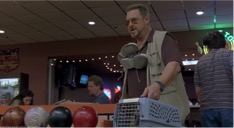
The way these two shots have worked together is by creating a fast paced movement throughout the particular location in the bowling alley. This has catered to show more than half of the set, to give the audience orientation to the character’s surroundings, as well as introduce all three characters in the scene fluidly. The shot also allows for each character to be positioned in the rule of thirds, while showing each character as primary and secondary by how close they are to the camera. For example, The Dude (the protagonist) is in the foreground, Walter (his best friend) is in the middle ground, and Donny (the silent, but necessary tag-along) is in the background. However, while Donny is in the background, he is in the middle. This reflects how he is the glue between The Dude and Walter’s friendship, which is shown to deteriorate after Donny’s death, later in the narrative. 2
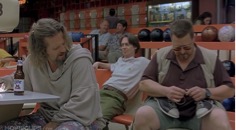
Analysing the Coen’s reasons for certain camera angles and shots is always fraught with the possibility of reading into unintended meaning behind them, hence, I will now analyse this with a grain of salt, so to speak.

While this one still shot of the trio is briefly broken to show Walter’s ex-partner’s Pomeranian which he has brought to the bowling alley with him, the still shot remains focused on this portrait of their banter. That is until Walter suddenly yells “Over the line!” mid conversation, to an opposing bowler that they are competing with. The scene has now gone from a menial conflict over Pomeranians to a bowling technicality battle between Walter and ‘Smokey’. The shot then cuts to Smokey standing at the edge of the bowling lane, turned and confused at Walter’s exclamation. The positioning of Smokey is in the dead center of the frame, with a lot of headroom. This creates the isolation and ostracism that Smokey feels, as he has just been yelled at, rather than conversed with. This would come across unusual in a relaxed sport like bowling. This also serves to kick start the tension that will now unfold, immediately layering over the ridiculousness and comedy of the scene. The scene then turns into an argument between Walter and Smokey over whether or not Smokey’s toe was “over the line” which would result in a technical foul, and a score of zero. The scene intensifies, as Smokey combats Walter over this issue, by getting closer to Walter, and the frame becoming tighter around the character, reflecting his argumentative behavior.3
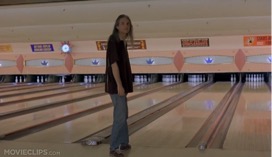
For the second time in the scene, we see a swing pan of the camera, but this time it is focused on Smokey, walking over to the scoring table to “mark it an eight”. The purpose of this is to show Smokey’s swoop into marking the score sheet with an eight to his name, initiating Walter’s outrageous reaction turned from verbal to physical. The camera then jumps to Walter pulling a pistol from his bowling bag and preparing it to fire. 4This gives the audience a close look into what Walter is currently unwrapping, pre-empting a surprised and sense of disbelief from the audience. The fact that a character would pull a gun on another over an argument about bowling serves to get in-touch with the style of the film as a ridiculous and hilarious series of events. 5
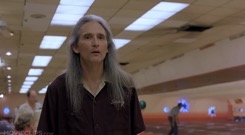
The camera shots then turn to a series of cuts between a high angle medium close up of Walter and The Dude, and a close up of Smokey, as he is stunned with fear at the presence of the gun. The high camera angle over Walter’s serious face as he holds his pistol beside his head in a threatening way is used to communicate Walter’s emotion, and that he is ready to get out of his chair. 6The reason that I believe that he will rise from his chair is because the high angle allows for the actor to stand and have his head still in the frame, due to the height that the camera is set up prior to the shot. It is an effective method to show the actor really ‘getting in your face’ and causing a feeling that the audience cannot escape the action on screen.
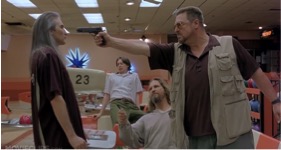
The two-shot involving Smokey and Walter’s altercation is a wide shot displaying all characters, their strange emotional reactions to the events, and the life and death situation playing out, once again enhances the comedic effect of the entire film as a weird farce of events with characters who are very mentally unstable. The Coen brothers mainly focus on style and audience reception among all other aspects of film, therefore the intimate analysis of such camera shots would lead one to gain an understanding of how they can capture and develop their styles so well.

This scene in particular is one of my favorites among cinema.