Scene In Cinema Camera Coverage #2: The shining

Stanley Kubrick’s psychological horror The Shining (1980), adapted from Steven King’s third published novel of the same name, explores the mental deterioration of writer and recovering alcoholic Jack Torrance (Jack Nicholson), while staying at the isolated Overlook hotel with his family, during his time working as the hotel’s caretaker.

Throughout the ominous bathroom scene from the film, the particular camera coverage effectively embodies Kubrick’s distinct visual style and shot composition evident throughout the influential filmmakers acclaimed filmography.

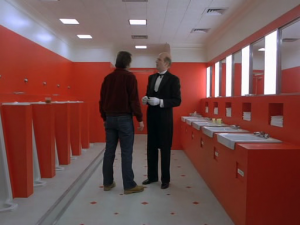
A signature Kubrick-esque motif, which is heavily employed throughout the film, is the use of symmetrical shot composition. Immediately as Jack Torrance and Delbert Grady (Phillip Stone) enter the bathroom, the scene is presented to us as a wide-angle shot framed symmetrically as a one-point perspective. Subsequently, the cinematography throughout the rest of the scene is framed with the actors accurately positioned in the center of the frame within the spatial constrictions of the bathroom. Accompanied by the lingering duration of the camera shots, the near perfect symmetrical cinematography creates a strange and eerie feeling, which greatly reflects the nature of the films ambience.
vlcsnap-75490vlcsnap-75623

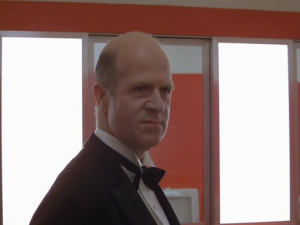
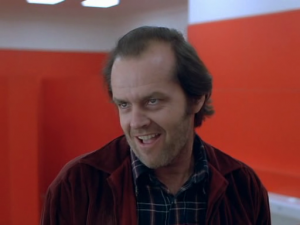
However the most astounding aspect in this scene is the ingenuity behind Kubrick’s use of space, his deliberate positioning of the actors within the environment and the way he uses the camera to capture the scene, which effectively heightens the films surrealism. As soon as the camera cuts to the second shot after Jack hears Delbert Grady introducing his name, the camera cuts to a shot positioned directly from the other side, thus breaking the 180-degree rule of cinematography. This has been deliberately employed in order to create a strange visual flow to disorientate the viewer and to emphasize the tension created between characters in the story world. Apart from the initial wide shot and the second Medium wide shot which depicts Grady and Torrance both in frame, the following intercutting single shot close-ups isolate the two characters from each other. While Torrance faces the direction of the mirror and is surrounded by the red colour of the bathroom walls, Grady stands in font of the mirror and is bathed in bright near overexposed backlighting. Consequentially with the construction and planned positioning of the actors in these shots, the director effectively depicts the mental deterioration and insanity of the films protagonist. By creating Grady’s inhuman and spirit-like appearance, Kubrick enables the audience to question his existence, supplying us with the feeling that Torrance is actually talking to himself in the mirror. Lastly, as he’s surrounded by the colour red in the bathroom, it symbolizes the foreshadow-ment of Jack Torrance’s evil hunger for murder.
vlcsnap-74450vlcsnap-75251

Short story Draft 1

WORKING TITLE: “BOGART”

(A short story condensed from a 7-page screenplay with multiple scenes)

It’s Eight o’clock on a rainy Saturday night. Mark awkwardly sits beside Kate on the living room couch in his apartment. Smart, elegant, blonde and beautiful; she’s a nine of ten. As they face the television screen in silence, Mark turns to Kate in attempt to speak, but instead, he simply smiles. He looks off to the corner of the room to see his cat clawing away at his tongue on the floor. He double takes and the cat is gone. She forcefully smiles in return and turns back towards the television screen. Suddenly, a voice breaks the silence.

“Getting any action?”.

A large vapor of cigarette smoke is blown towards Mark. He coughs and looks to his left. A mysterious man sharply dressed in suit and tie underneath a large beige colored trench coat has suddenly appeared, sitting next to him on the couch. As the man’s black fedora shades his face, the illumination of a red spark glows each time he inhales his cigarette. The man, sporting a heavy Humphrey Bogart-esque voice, seems to be a figment of Mark’s imagination, as Kate takes no notice of him.

“This was a terrible idea. You said an easy way for me to get to second base was to put on a horror film”, says Mark.

“She’s not scared?”, the man asks.

“What do you think?”

They both turn to see Kate apathetically yawning while sounds of a chainsaw emerge from the television.

“Hey, I never said I could read minds”. The man hands Mark a business card. “You can call my third cousin’s, nephew’s, sister’s, flat mate for that. She’s a pro”.

Mark tears the card in half.

“Besides, having your first date with a broad at this dump…” The man shakes his head. “For Christ sake, what were you thinking?

“You said you were going to help me out”, says Mark.

“Well, you could start by sitting up straight. Arm around shoulder”.

Mark corrects his posture and puts his arm around the man.

“Not my shoulder, idiot. Arm around hers”.

Mark slowly moves his arm around Kate. He looks at her and smiles.

“Now move in for the kill”, says the man.

Mark draws out a sharp kitchen knife from under the couch. The man quickly slaps Mark across the face, causing him to drop it.

“As in kiss her, not commit homicide”.

“What, kiss her right now?”.

“Or I could pencil you in for next week”, offers the man sarcastically while holding out a black diary. “Yes, do it now!”, he demands, as he throws it away.

Mark turns and sees Kate, having left the couch, standing near the front door. She gathers her bag and picks up her coat, preparing to escape.

“Kate, where are you going?”

“Sorry, early start at the office tomorrow”, she says without hesitation.

“Tomorrow’s Sunday”.

“Alright, to be honest this is just weird… I’ve gotta go”.

She opens the door. “Oh and tell your friend, that he’s not invisible. Anyone with a pair of eyes can see him”, she says before briskly shutting the door behind her.

Mark and the man sit in silence.

“You think she was talking about me?”.


Scene In Cinema: Week #3 Reflection/ Epiphany

I really enjoyed my third week of Media 5 classes. Both classes maintained my expectations and understanding of the progressive nature of these classes. Essentially, moving forward each class by working on similar scene breakdown tasks and expanding upon the basic work we were given initially in the first week. However each time we undertake these practical tasks, we are encouraged to systematically delve more into the complexities to effectively explore the processes of scene production in filmmaking.

Wednesday’s class was essentially a post-production session, as we were given 3 hours to edit our group’s video, which we shot under the constraints of our second week’s task, in order to compile our scene. After properly inspecting the clips in the edit suits, I was quite please with my groups performance on shoot as the quality of our clips were aesthetically pleasing. After a couple hours of cutting and organizing the shots in an organized linear structure, color grading, and adding sound effects, I was done with my version of the scene, and proud of it. I’m not sure if it was due to my acting specifically, but I interpreted the scene to exhibit a creepy/ darker overall mood, reflected through the reduced brightness and higher contrast color correction, with a hint of comedic relief, which is evident from the music I used to accompany the video.

Fridays class was rather similar to most classes in terms of the whole group production exercise given, which I have no complaints about, however this time Paul instructed us that each of us will direct our own individual scene without the creative input of others. For a split second I was rather surprised as each other exercise was shot as a group collaboration. However within seconds I came to my senses to recall every single experience I’ve had working on a film, television, music video or any type of video production. Each and every active crew member on set has had their own duty. Although everyone works in a collaborative manor to achieve the same result, the successful completion of the specific production, almost everyone (everyone working in their own department) works independently to fulfil their rightful position. Which is what influenced this weeks epiphany.

It felt strange for me to realize that this has been the first time I had ever extensively thought about the true collaborative nature of filmmaking, influenced by Paul’s in-class discussions regarding this topic. Although I still believe that filmmaking is the most collaborative form of art, at the same time I understand that its still an independent form of work, once we analyze the specifics of what everyone actually does. Whether it’s the director, in charge of the visuals and performance (and sometimes the technical stuff) or the camera operator and the sound recordist, who are respectively in charge of capturing the audio and visuals. People who work in separate departments hardly ever experience their jobs crossing over to another department (There has been some occasions tho such as the Director who might also be the DOP). I strongly doubt that the boom operator would consult with the cinematographer in regards to his ideas of how the camera coverage should be executed, on professional production shoots.

But at the end of the day everyone works to get the same result. So is filmmaking a true collaborative form of work? Yes and No to certain degrees. Yes; as all crew members work together to efficiently complete a film. Yet simultaneously no; as everyone in their own department has their own duties and responsibilities to accomplish the completion of the film.


Scene In Cinema: Week #2 Reflection/ Epiphany

I was told to read more books this week to further my studies for the Short story writing course. I’m rather apathetic when it comes to reading anything over 201 pages (go figure). However, this week after the constant focus on scenes in films rather than its entirety, I’ve come to realization that my inspirations for all my work, wheather I’m writing or “making” a short film (actively participating in at least one area of all stages of filmmaking from Pre, on and post-production, maintaining creative control), I’m only inspired by visuals. Anything I can see. Mostly films, television, paintings, absurd situations I observe or somehow find myself to be involved in life. Things like that. I’ve come to this realization after watching a few of my favorite films before beginning to write my analysis on camera coverage for the Found scene exercise. Even a Salvador Dali painting, which will always rapidly imbed itself in my mind whenever I see one, will instantly make more sense to me, rather than anything Hemingway or some other alcoholic ever wrote. I only believe what I see.

Unknown


Class Reflection:

I thoroughly enjoyed our second Friday class for Media 5. After getting into groups again to conduct our practical exercise, I began to see the progressive structure of the course. As each time we are assigned to complete these similar scene blocking exercises, we have been asked to do something additional. From our first Wednesday Class, being given a script and told to only capture the scene without recording it on our camera, we progressed our second Wednesday class, to do the same exercise under the same conditions, only this time to hit the record button, to capture our rehearsed scene in strict order without editing, thus practicing the in-camera editing technique. On this occasion however, were asked to do the same thing, except to actually have a post-production stage to edit the shots we had filmed. Effectively before we left the classroom to begin filming, my group members and I all marked up the scene synopsis we were given and deliberated how we all envisioned the camera coverage should be set up. While “on-production”, our group was effectively able to rotate all production roles around. And when I say all, I mean ALL roles. Including acting, which I have no idea how it will look, once we have all individually edited our versions of the shots into one scene. Additionally, I really enjoyed having the chance to be placed in a group with people who I had never worked with, as I believe we collaborated well in executing this assigned task. I look forward to see how all the shots look once I begin editing the clips together.

Scene in Cinema: Found Scene

SCENE LINK: https://www.youtube.com/watch?v=03QHVB_n6N8

Slapstick, facade, animals, animated foreign non-American characters and chaos. These are some of the signature ingredients found in the recipe for Blake Edward’s cult classic film “The Party” (1968), starring his longtime collaborator and British comic legend, Peter Sellers. A true auteur, Blake Edwards who’s credited as the writer, director and producer of the film, presents us with his homage to classic slapstick traditions from the silent era of cinema.

Early into the film, Edwards introduces the films protagonist; Hurundi V. Bakshi (Sellers), an accident-prone Indian actor, who constantly manages to cause problems despite his good intentions. As he inadvertently manages to detonate explosives on set of a film production, seconds before it’s scheduled for detonation, Bakshi is not only fired but also chased off set by the director. Instead of being blacklisted from Hollywood, he is put down on the guest list, receiving an invitation to a lavish Hollywood party by mistake. Throughout the remainder of the film, Bakshi systematically creates mayhem resulting in the destruction of a house, loss of ones sanity and a clean elephant, by the conclusion of the party and the film in its entirety.

During the scene where Peter Sellers’ character walks around aimlessly in the mansion observing the party guests, he maintains the social awkwardness of Bakshi. This is expressed not only through the performances and positioning of all the actors, but additionally the specific way the camera is used to capture the scene

.Screen Shot 2015-03-12 at 10.01.36 PM

The moment where Bakshi leaves the couch and walks over to some of the party guests, a medium long shot is used to show Bakshi’s positioning; in contrast to the others. While the trio, standing above him on the stairs, are drinking smoking and laughing; Bakshi, alone, is standing ground level and below the group. From the following close-ups, not only is Bakshi’s shots separated between the frames with only himself in shot, he is looked down upon the partygoers on the stairs who are all in the same frame. This makes him seem rather socially inferior and distant to everyone else.

Screen Shot 2015-03-12 at 10.02.39 PMScreen Shot 2015-03-12 at 10.01.53 PM

When Bakshi progresses to disrupt the congressman’s anecdote, the long and lingering camera coverage is used to maintain a slow temporal pace. In addition to the contrasting shots between Bakshi and everyone else, the lingering shots creates the cringe humor to settle in, as a result of the lack of time passing from the moment Bakshi opens his mouth, verbally exemplifying his lack of comprehension due to the cultural barrier he faces. Thus effectively portraying Seller’s character as the ultimate awkward “foreigner”.

Screen Shot 2015-03-12 at 10.04.12 PMScreen Shot 2015-03-12 at 10.05.20 PM

Scene In Cinema: Week #1 Reflection/ Epiphany

To summarize my initial reaction to Media 5, it matched approximately 60% of my expectations for what I thought this class would potentially encompass. Despite this, I was pleasantly surprised that we got the opportunity, in our first class for the year, to grab a camera and block out our assigned scene, in collaboration with our group members. Having the experience in freelance and ch31 production groups as well as a technical qualification in Film and television production, I was within my comfort zone, and greatly appreciated the nature of the exercise. As I was expecting more theoretical work (which I assume will inevitably consume the majority of this course) I was really contented to do this kind of practical work. It really challenged us to use our minds to deliberate and achieve an interestingly effective shot to comply with our restrictions of maintaining a single shot for the entire dialogue between two characters in a scene. After the completion of rotating roles between group members during the blocking our scripted scene, It was great to demonstrate our best take of our rehearsals with the camera in front of class and see other peoples interpretation of the camera coverage from the scenes they were given to work on. According to observation and my beliefs, filmmaking is the most collaborative art form, therefore I hope to look forward to more practical in-class group work, such as our first Media 5 exercise for 2015.